Learn how cultural technical designer Timothy Staton-Davis is charting a new path in game development, drawing from his experiences across the industry to drive games where the technical implementation is inextricably linked with narrative and game design goals. In a game industry crowded with 10,000+ releases a year, the ability to craft unique experiences that immerse players in specific emotions, experiences, and educational moments is a differentiator that may mean the difference between surviving and thriving for you, your game, and your studio. Timis now Creative Director at Melanated Game Kitchen, taking his unique skills and putting them to use in exciting new indie games suspense and strong emotions and build empathy and resilience along the way. As a community organizer and educator, Timothy has also been taking his experience to the broader community for years, from his time on the board of Black in Gaming helping early career developers get started to his most recent role as adjunct instructor with the University of Southern California’s storied Game Innovation Lab. In this episode, explore the nuances of localization, culturalization, cultural technical design, AI use in modern game development, and as with most episodes in this season of Enduring Play you’ll also learn more about how to connect your work to a broader, thriving game development community of students, educators, and professionals.
Listen Now: Enduring Play Season 2 Episode 8
Key Quotes
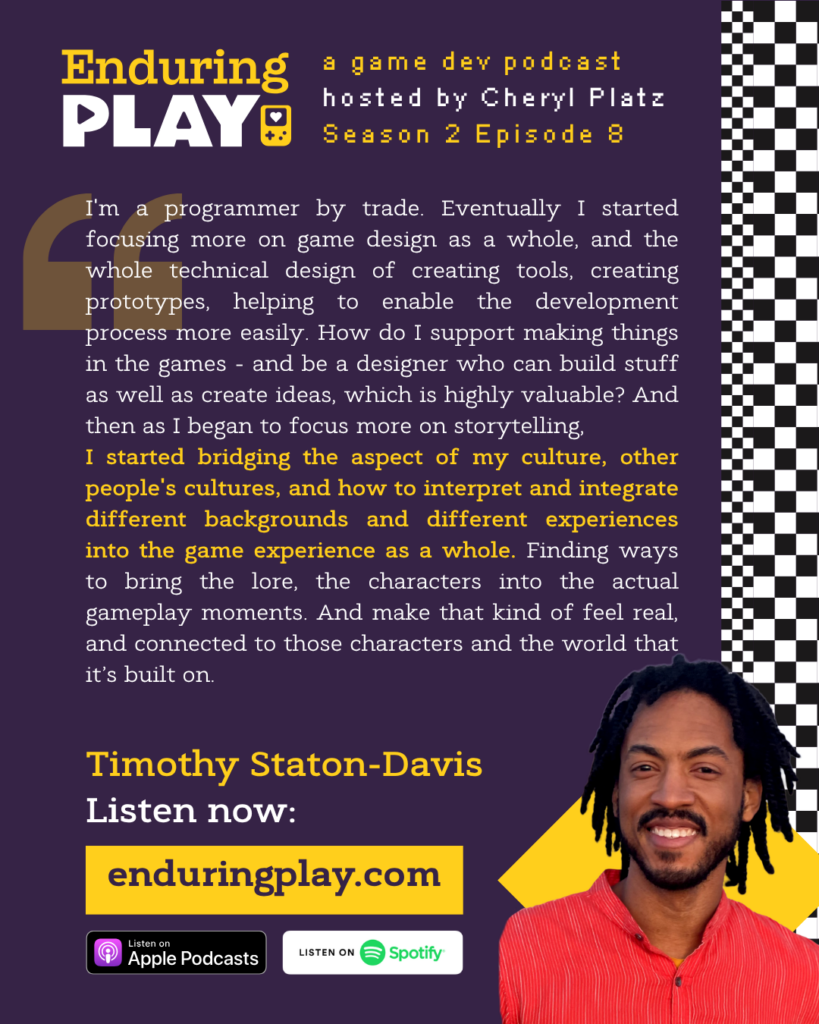
I’m a programmer by trade. Eventually I started focusing more on game design as a whole, and the whole technical design of creating tools, creating prototypes, helping to enable the development process more easily. How do I support making things in the games – and be a designer who can build stuff as well as create ideas, which is highly valuable? And then as I began to focus more on storytelling. I started bridging the aspect of my culture, other people’s cultures, and how to interpret and integrate different backgrounds and different experiences into the game experience as a whole. Finding ways to bring the lore, the characters into the actual gameplay moments. And make that kind of feel real, and connected to those characters and the world that it’s built on.
When you’re trying to dig into detail on a world – this is fictional and non fictional worlds and backgrounds – you may not find all the information just on a normal search just checking one of the AI logs: “Search this for me. And pull this up?” You’ll get some stuff. But it’s just going to be very surface level. You’re not going to capture a lot of that more detail of the people who are actually immersed in this world. It’s going to be very caricatured. And so it does require another level of digging, or just like talking with the right people, or getting the right books or the right reference material to properly represent what you’re building. And that takes time, and it takes some effort.
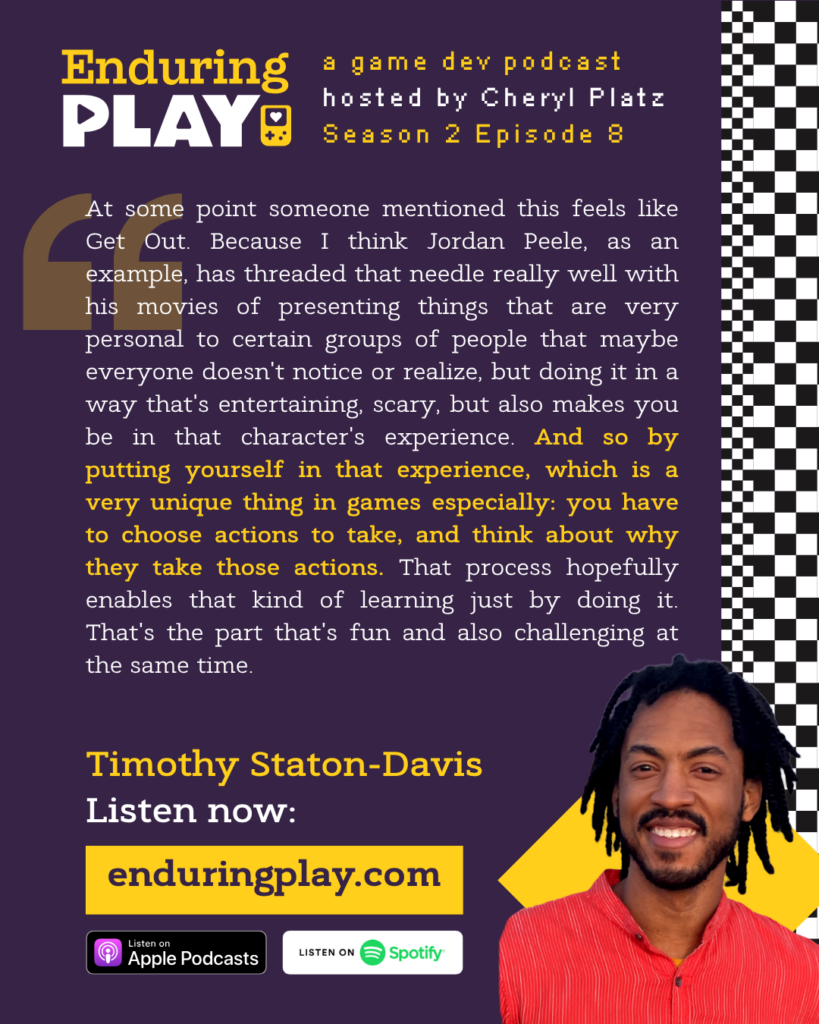
At some point someone mentioned this feels like Get Out. Because I think Jordan Peele, as an example, has threaded that needle really well with his movies of presenting things that are very personal to certain groups of people that maybe everyone doesn’t notice or realize, but doing it in a way that’s entertaining, scary, but also makes you be in that character’s experience. And so by putting yourself in that experience, which is a very unique thing in games especially: you have to choose actions to take, and think about why they take those actions. That process hopefully enables that kind of learning just by doing it. That’s the part that’s fun and also challenging at the same time.
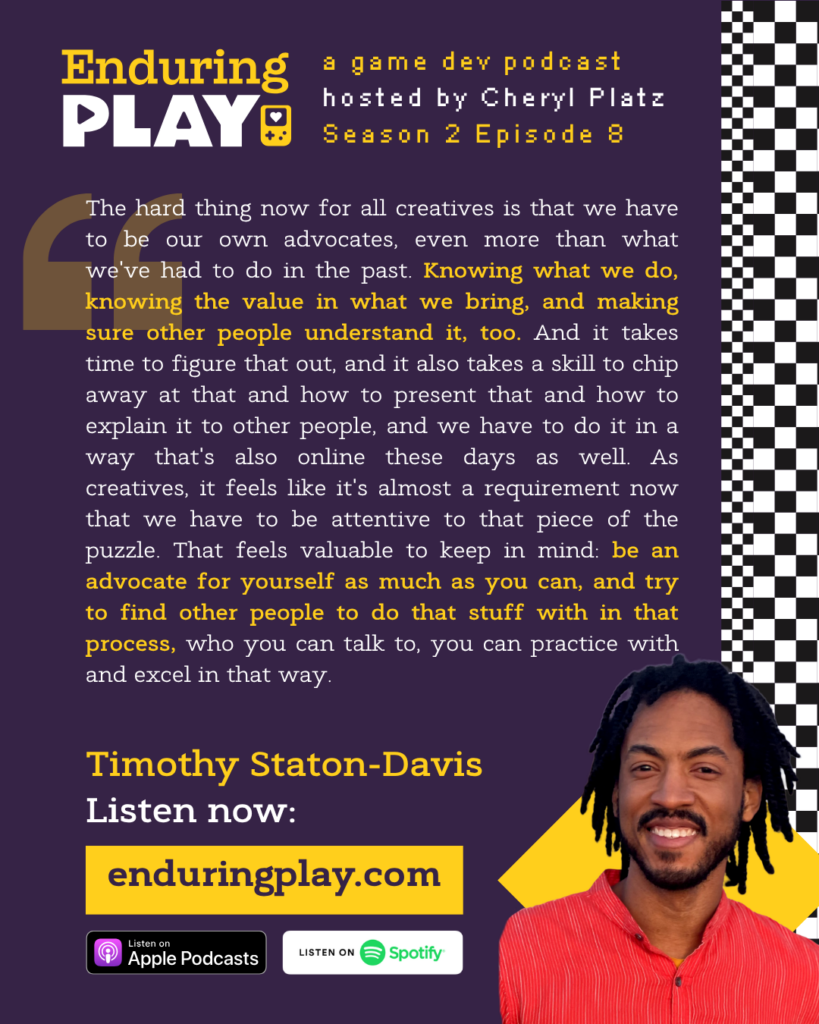
The hard thing now for all creatives is that we have to be our own advocates, even more than what we’ve had to do in the past. Knowing what we do, knowing the value in what we bring, and making sure other people understand it, too. And it takes time to figure that out, and it also takes a skill to chip away at that and how to present that and how to explain it to other people, and we have to do it in a way that’s also online these days as well. As creatives, it feels like it’s almost a requirement now that we have to be attentive to that piece of the puzzle. That feels valuable to keep in mind: be an advocate for yourself as much as you can, and try to find other people to do that stuff with in that process, who you can talk to, you can practice with and excel in that way.
Social Media Gallery

Follow Enduring Play